
Buyer reference11 min read
What Resale-Ready Should Mean Before You Buy the Lot
“Resale-ready” is a large promise to fit into two words.
By Zain Qureshi, Founder, Second Spin SupplyLinkedIn (opens in a new tab)
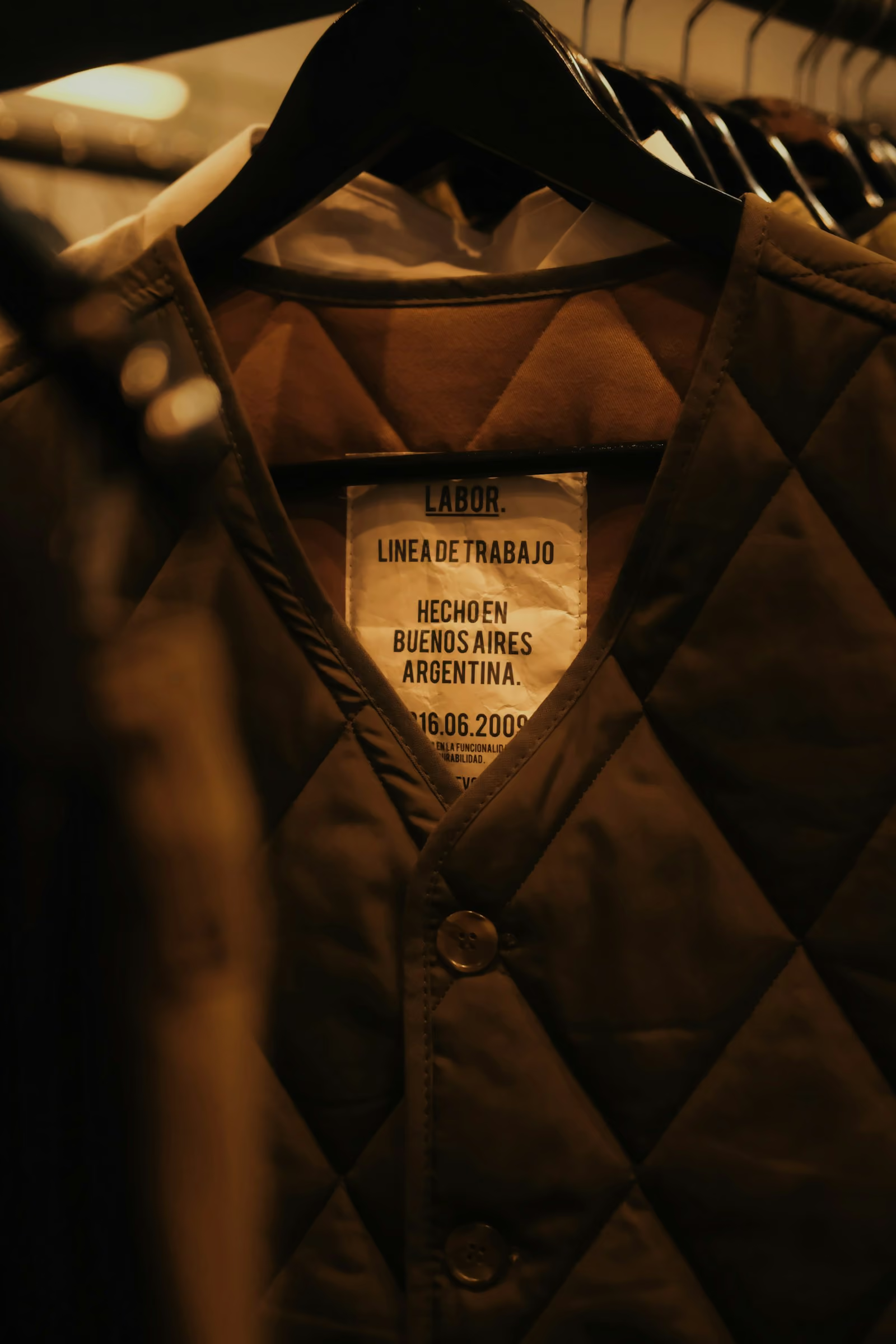
For one buyer it means stock can go straight onto a rail after receiving checks. For another it means the garments are suitable, but measuring, photographing, and describing them remain the retailer's job.
Both buyers can be reasonable. They can still misunderstand the same offer.
A useful resale-ready claim names the work already done, the condition included, and the work left for you. If those details are missing, you have a promising phrase rather than a buying standard.
Start with the job the stock must do
A vintage store choosing pieces one by one may accept variation that complicates a fast live show. An online seller can describe an unusual flaw carefully, but still needs the time to photograph it. A small shop with no repair capacity may need a stricter condition brief than a business built around restoration.
The garment doesn't change when the buyer changes. Its suitability does.
Before requesting a quote, write a short definition of ready for your own business. For example: “We can measure, photograph, and steam when appropriate. We are not buying pieces that need repairs. We need condition exceptions shown before ordering.”
That is an illustrative brief, not an SSS service specification. Its usefulness is the boundary it creates. The supplier can tell you whether an actual selection fits it.
Include the selling format. The information needed for a physical fitting room differs from the information needed for a buyer choosing through a phone screen.
Grade letters need a translation
Grade A, Grade B, cream, premium, and credential are terms a buyer may encounter. Don't assume two suppliers attach identical definitions to them. Ask for the written description that governs your particular order.
A concrete example helps: Fleek's published grading guide allows tiny, easily washable stains within Grade A and includes a stated grading margin of error. That is Fleek's own policy, with additional category details; it is not a definition for every supplier. Read the full guide before interpreting a Fleek lot. Fleek product grading (opens in a new tab)
The lesson isn't that grades are dishonest. It's that a label becomes useful when you can connect it to observable condition and applicable terms.
Ask the supplier to show what counts as acceptable wear, what counts as a defect, and what happens when a delivery falls outside that description. Ask whether the assortment intentionally mixes grades and whether category exceptions apply.
If a grade description mentions washable stains, don't quietly translate that into “already washed” or “certain to come out.” Those are different statements.
The Resale-Ready Test
At Second Spin Supply, this is the standard I'd want a buyer to use in the conversation. Use it to assess a particular lot against your business's requirements.
1. Identifiable: can you describe what you're buying?
You should understand the category and the important limits of the description. “Branded clothing” may cover several types of stock. “Vintage” needs item-level support if age is part of the value proposition.
Look for readable labels where they are present, garment photographs, and a clear explanation of missing information. A visible logo doesn't establish authenticity by itself. If authenticity or a specific production period is essential to the purchase, ask what evidence supports it.
The goal is an accurate description your business can stand behind. “Label unreadable” is usable information. An invented material or date isn't.
2. Understandable: can you assess the assortment?
Ask about the quantity basis, sizes, category mix, and selection method. Is the quoted price per piece, per unit of weight, or for the entire lot? Are pictured pieces the exact goods being offered?
A single excellent jacket doesn't explain the rest of the bundle. A wide rack video doesn't necessarily establish sizes. A sample needs to be described as a sample, including how it was selected.
Useful information should let you explain the lot to someone else without having to guess. If you cannot summarize what is included, the offer needs another conversation.
3. Presentable: does condition fit your selling standard?
Presentable doesn't require every garment to look new. It requires wear to fit the promise you make to your customer.
A faded work jacket can belong in a deliberate assortment. A hidden closure problem can create a very different customer experience. Evaluate both the visible character and the functional details.
This is where reference photographs help. Show the supplier examples of what your shop accepts. Ask them to show examples from the proposed stock. You are building shared meaning around condition, not simply collecting reassuring adjectives.
4. Priceable: is there enough information for your economics?
You need more than the purchase price. Identify transport and other order-specific charges, the work you'll perform, the likely selling channel, and what information you need to research comparable items.
Useful stock can still be the wrong purchase if the preparation work exceeds what your business can support. Equally, a higher purchase price can be worth considering if the actual selection suits your customer and the remaining work is manageable.
Don't treat either outcome as automatic. Write down the inputs. Where you need a sales comparison, compare genuinely similar garments and completed transactions, not just hopeful listing prices.
5. Placeable: can you name its next selling opportunity?
Which rack, shop section, listing category, or show would receive these pieces? Which customer is the offer for? When could you realistically put it in front of them?
“I'll find a way to sell it” can be an expensive answer when you already have unprocessed stock. A clear selling use gives you a reason to choose the lot and a way to review the decision afterward.
Identifiable. Understandable. Presentable. Priceable. Placeable. Five questions, answered in the context of your business.
Inspect by category, not by optimism
Build your condition check around the garment in front of you.
| Category | Details to see clearly | Question to resolve |
|---|---|---|
| Puffers and outerwear | Closures, cuffs, collar, lining, seams, missing detachable parts | What can be stated about condition without implying unverified performance? |
| Denim and workwear | Waist, inseam, hems, knees, seams, closures, repairs | Is wear part of the intended look, or work the buyer must do? |
| Polos and tees | Collar, underarms, seams, print, tag, actual measurements | Does the garment support an honest description of fit and wear? |
| Knitwear | Holes, shape, pilling, seams, label and measurements | Can the buyer handle the care or preparation this particular piece needs? |
| Activewear | Elastic, seams, lining, opacity when relevant, labels | Does it remain suitable for the use the buyer plans to describe? |
These are inspection prompts. They don't establish a cleaning, testing, or authentication service. If a buyer requires a specific process, that process needs its own agreement and evidence.
Also inspect for problems that don't photograph well. Odor, fabric feel, and some hidden damage may remain uncertain during remote review. Say what a video can establish and what receiving inspection still needs to establish.
What a useful stock video should show
I'd begin by identifying the lot and the date. Then I'd establish whether we're looking at the exact selection or an example of the category. That gives every subsequent close-up a context.
Ask to see garments from more than the most photogenic part of the rail. Request fronts, backs, relevant interiors, labels, and known flaws. Where a buyer asks about fit, show the measurement clearly rather than reading it over a shaky camera movement.
The best evidence is tied to a decision. A close-up of a denim hem can answer an alteration question. A zipper opening and closing can answer a closure question. A slow pan past many labels may still leave both unresolved.
Save the relevant evidence with the written lot description and order terms. A conversation is easier to revisit when the images and the description identify the same goods.
A useful stock review ends with fewer open questions and a record both sides can revisit. Make the evidence easy to find when it's time to confirm the order or inspect the delivery.
Agree on the exceptions before the parcel arrives
An exception is only useful if it is specific enough to affect the decision.
Ask whether flaws are disclosed per item, expected within a stated portion of the lot, or governed by a written grade policy. Clarify which descriptions take priority if a video, listing, and message appear inconsistent.
Then ask how a discrepancy is handled. What evidence should the buyer keep? How soon must a problem be reported? Who reviews it? What remedies are actually available? Who handles any return movement?
Put the answers in the order record. Ask for the policy that applies to your particular purchase. A helpful conversation still needs to lead to agreed terms.
If the seller can't answer a material question, reduce the uncertainty before increasing the order. That might mean more evidence, a different assortment, a smaller trial where available, or a decision to pass.
A receiving routine you can use
The arrival of a lot is a handoff between the supplier's description and your business's own records.
- Identify the order. Match the delivery to the lot description and retain packaging and shipping identifiers while checking it.
- Confirm quantity. Use the agreed basis: pieces, weight, or another documented measure.
- Inspect against the promise. Use the actual grade and exception terms, not a new standard invented after arrival.
- Record discrepancies. Photograph affected garments clearly and keep them identifiable. Follow the agreed reporting procedure within its deadline.
- Separate work states. Create distinct groups for ready to prepare/list, known preparation, unresolved questions, and items outside the agreed description.
- Preserve the evidence. Avoid altering or selling disputed items before understanding the applicable process.
- Release stock into your workflow. Measure, describe, prepare, or merchandise as your business requires.
Don't let one exciting piece pull attention away from the rest of the delivery. The lot is the unit you bought. Review the whole commitment even when the eventual listings are individual.
Measure what readiness costs you
Keep a receiving log simple enough to maintain. Record the lot, arrival date, pieces received, pieces needing each kind of work, time spent preparing, and date the stock first becomes available for sale.
Separate condition problems from preference problems. “Outside agreed condition” is different from “I bought a color my customers didn't respond to.” Both deserve attention, but they lead to different supplier conversations.
Track pieces that remain unlisted as well as pieces that sell. A lot can look promising in a sales report when the report leaves out half the stock still waiting for preparation.
If you calculate a ready-to-list share, define the numerator and denominator explicitly: pieces meeting your stated ready-to-list standard divided by pieces received. Use the same standard across the lots you're comparing. This is your operational measure, not a universal industry benchmark.
The log should help you write a better next brief. It doesn't need to become a complicated dashboard to earn its place.
What a good supplier conversation sounds like
The useful questions are often ordinary: “Can I see the cuffs?” “Are those the pieces in the order?” “What sizes are included?” “What preparation should I allow for?”
Second Spin Supply's role is to make a buyer conversation about secondhand apparel possible across its Austin-facing relationships and Karachi-connected stock operations. The point of direct access is that you can ask about the details that affect your business.
Use that access. A supplier should be able to explain the offer in terms you can assess, including its limits.
And offer useful information in return. Tell the supplier your selling channel, preparation capacity, condition threshold, and category requirements. The better the brief, the easier it becomes to recognize a suitable selection—or an unsuitable one—before money and time are committed.
A standard worth keeping
Resale-ready should leave you with a clear next step.
You can see what you are buying. You know which work remains. You understand the order terms. You can place the stock into a selling plan that belongs to your business.
That is a more useful promise than “great brands” on its own.
Save the wholesale buyer's questions for your next inquiry. If you're comparing a sourcing marketplace with a direct relationship, read the Fleek and direct-supplier guide.
Want to assess a current SSS assortment against your own standard? WhatsApp Zain (opens in a new tab) or Email Zain with your category, approximate quantity, destination, and the preparation work you can take on.